The Shift from High Performance to Sovereign Leadership


Many high performers believe that consistent delivery naturally leads to recognition, influence, and promotion. While this notion seems rational, it does not reflect the reality of leadership progression.
Organisations assess more than just competence. They evaluate readiness. They consider how you think, communicate, handle uncertainty, and whether others trust you to operate at the next level. If your leadership is only visible through execution, you are likely under-positioning yourself.
Competence earns you trust to deliver. Positioning earns you trust to lead. This is why many capable professionals find themselves stuck. Their contributions are valuable, but their leadership remains overlooked because their thinking, influence, and strategic value are not fully visible.
The Difference Between High Performance and Sovereign Leadership
There are four key shifts that separate high performers from Sovereign Leaders.
Agency: High performers often wait to be recognised. In contrast, Sovereign Leaders take ownership of how their leadership is experienced. They understand that visibility and perception significantly influence opportunity.
Leadership Identity: Many professionals operate from the identity of their current role rather than the level they aspire to lead. Sovereign Leaders shift their thinking, communication, and decision-making before the promotion arrives.
Power Intelligence: Leadership progression is not solely driven by performance. It is shaped by trust, relationships, political awareness, and strategic alignment. Leaders who grasp this navigate organisations differently.
Strategic Positioning: Many professionals create value but fail to make it visible. Sovereign Leaders communicate strategically, connect their work to business priorities, and articulate their thinking in influential settings. If any of these dimensions are weak, progression will eventually stall.
Why Identity Matters More Than Behaviour
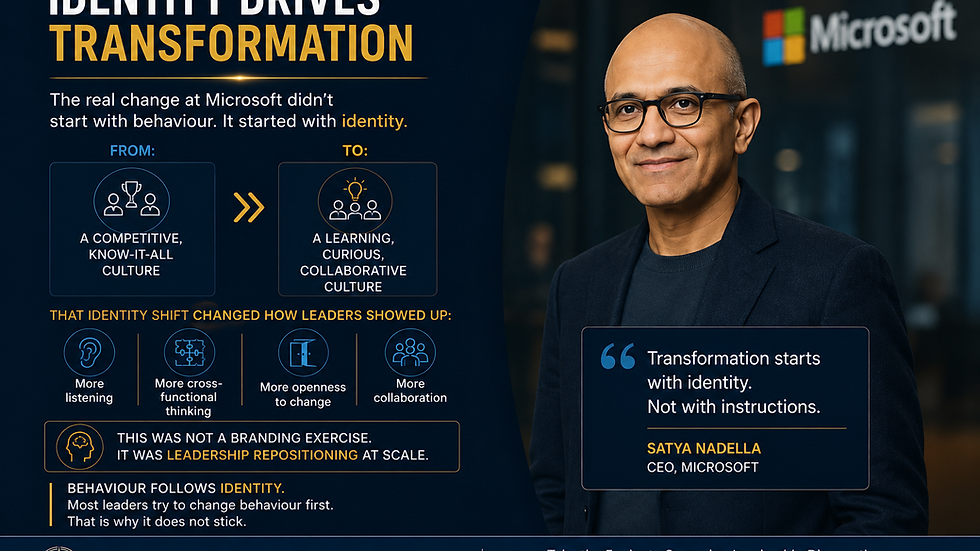
A clear example of identity-led leadership transformation is Satya Nadella at Microsoft. The company did not lack intelligence or capability; it lacked a leadership identity aligned with the future it needed to create.
Nadella shifted Microsoft from a competitive, know-it-all culture to one focused on curiosity, collaboration, and learning. This shift transformed leader behaviour across the company. Listening improved, cross-functional thinking flourished, and openness to change increased.
The key takeaway is that transformation begins with identity, not behaviour. Most leaders attempt to change behaviour first, which is why many leadership interventions fail to create lasting change. Behaviour disconnected from identity rarely sustains itself under pressure.
Competence Alone Is Not a Leadership Strategy
Many professionals unknowingly build their careers around being excellent executors. They become dependable, reliable, and operationally strong. However, leadership demands more than just doing good work.
If competence is your only strategy, you are playing the wrong game. Leadership visibility is not self-promotion; it is about helping others understand how you think, what you prioritise, and how you contribute strategically.
This means contributing perspectives instead of merely providing updates in meetings. It involves connecting your work to organisational priorities, discussing impact rather than activity, and taking positions instead of waiting for instructions. If others cannot see how you think, they cannot fully trust your leadership capacity.
Leadership Is How People Experience You
Leadership is not defined by intention; it is defined by experience. Your team and stakeholders constantly form conclusions about your leadership based on your patterns. They assess whether you are clear or vague, decisive or hesitant, grounded or reactive.
Competence answers one question: Can this person do the work? Leadership answers another: Can this person be trusted at a higher level? These are not the same.
Many professionals spend years strengthening their capabilities while neglecting how they are perceived by others. This often stalls their leadership progression. The shift into Sovereign Leadership begins when leaders stop defining themselves solely through performance and start consciously shaping their identity, positioning, influence, and strategic presence.
The Importance of Strategic Alignment
In today's complex organisational environments, strategic alignment is crucial. Leaders must ensure their actions and decisions align with the broader organisational goals. This requires a deep understanding of the business landscape and the ability to navigate it effectively.
Sovereign Leaders excel in this area. They connect their individual contributions to the organisational mission, ensuring that their work supports the overall strategy. This alignment not only enhances their visibility but also reinforces their leadership identity.
Building Trust Through Influence
Influence is a critical component of leadership. It is not merely about having authority; it is about earning the trust of others. Sovereign Leaders understand that trust is built through consistent actions, clear communication, and genuine relationships.
To enhance your influence, focus on building authentic connections with your team and stakeholders. Engage in active listening, seek feedback, and demonstrate empathy. When people feel valued and understood, they are more likely to trust your leadership.
Navigating Uncertainty with Confidence
In an ever-changing business landscape, uncertainty is a constant. Sovereign Leaders are adept at navigating this uncertainty with confidence. They embrace ambiguity and view challenges as opportunities for growth.
To cultivate this mindset, practice resilience and adaptability. Encourage your team to approach uncertainty with curiosity rather than fear. By fostering a culture that embraces change, you position yourself as a leader who can guide others through turbulent times.
Conclusion: Embracing Sovereign Leadership
The transition from high performance to Sovereign Leadership requires intentional effort and self-reflection. It involves recognising the importance of identity, agency, and strategic positioning. By shifting your focus from mere execution to a holistic approach to leadership, you can enhance your influence and drive meaningful change within your organisation.
Take the time to assess your leadership identity and consider how you can align it with your strategic goals. Embrace the journey of becoming a Sovereign Leader, and you will find that your leadership capacity expands, enabling you to navigate complex organisational dynamics with greater precision.
Take the Sovereign Leadership Diagnostic to assess your Agency, Leadership Identity, Power Intelligence, and Strategic Positioning: Sovereign Leadership Diagnostic


Comments